
An applicant tracking system is not a screening tool
Australian care providers keep upgrading their applicant tracking system. Hiring stays slow. The real bottleneck is assessment, not filing.
Ployo Team
Tag
Australian care providers keep upgrading their applicant tracking system. Hiring stays slow. The real bottleneck is assessment, not filing.

NDIS providers in Australia default to recruitment agencies for support worker hiring. What agencies cost, when they earn it, and when direct hiring wins.
HR recruitment software tracks where candidates are, not what they said. For Australian aged care and healthcare employers, that evaluation gap costs time.
Most teams investing in AI-powered recruitment marketing are solving the wrong problem. The funnel does not break at attraction. It breaks at screening speed.
Most AI recruiting software automates admin tasks. Here is the evaluation question it mostly ignores, and why that is the bit that actually matters.

Chief people officer recruiting goes wrong when the brief conflates two distinct jobs. Here is how to separate them and run a faster, sharper search.
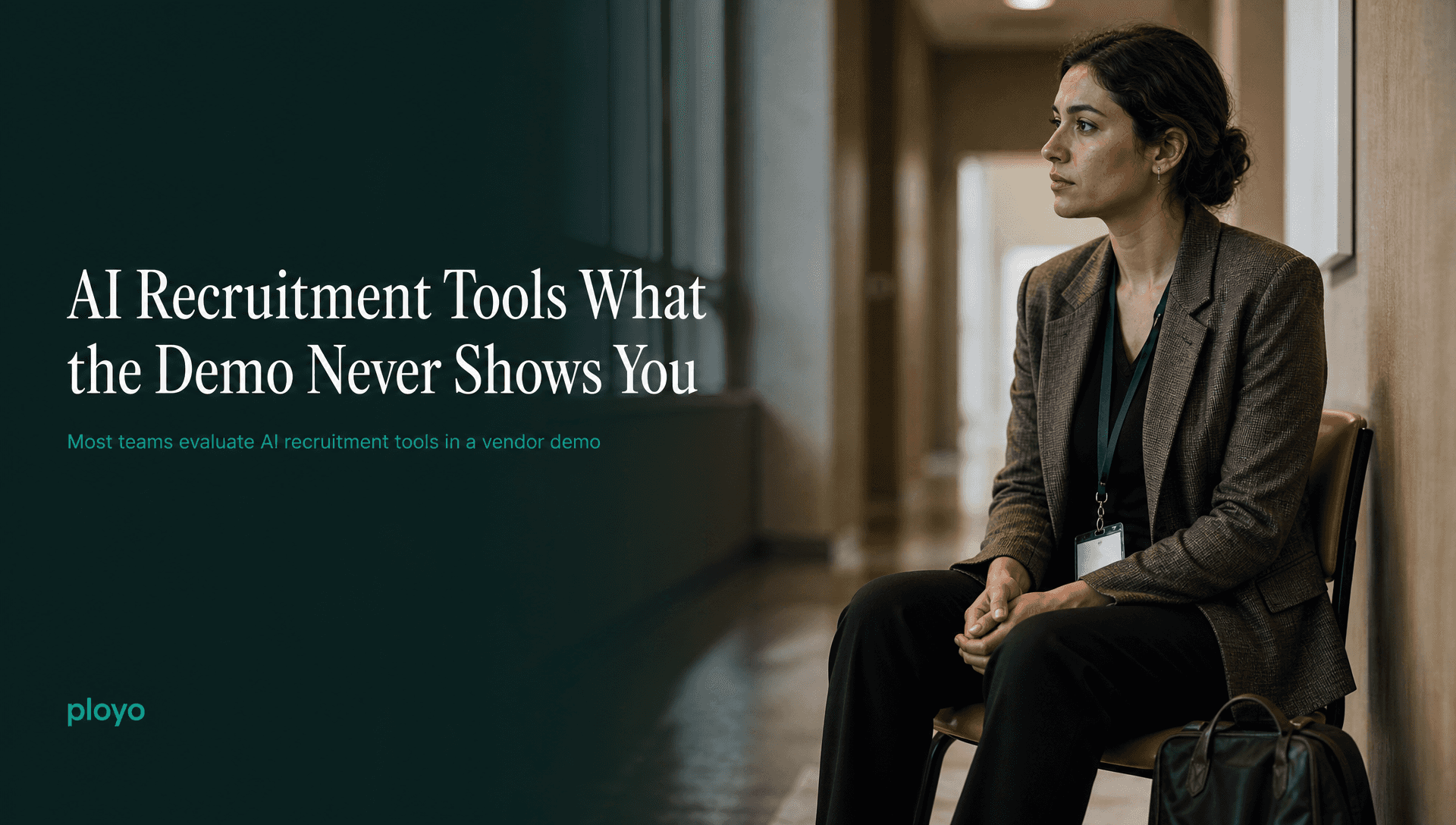
Most teams evaluate AI recruitment tools in a vendor demo. The questions that actually predict adoption success, and the one number every vendor avoids.

Most AI talent assessment tools score cognitive ability or personality traits. Here is what that misses, and how to choose tools that actually predict job fit.

Most AI recruiting tools automate resume screening. That was never the bottleneck. Here is what the real problem looks like and what to buy for it.

How many candidates in the first round of interviewing? Four to six, assuming your pre-screening worked. If you're shortlisting more, your screen is broken.

Why requiring prior care experience for NDIS support worker roles narrows your applicant pool, and what to screen for instead to find workers who last.

Why aged care and NDIS providers underestimate the true cost of staff turnover and how a better upfront hiring process cuts the replacement burden.

AHPRA registration confirms legal standing, not care quality. Here is what AU healthcare hiring still needs to assess beyond the registration check alone.

Aged care providers facing roster gaps usually blame supply. The candidates are there. A four-week hiring process loses them to whoever makes an offer first.

Most home care providers use the same process as residential aged care. Here is why that approach keeps failing and what a stronger process actually looks like.

Most aged care providers hire only from the experienced-care pool. That pool is exhausted and does not predict retention. Here is the case for career changers.

Behavioural interview questions assume a work history most care candidates don't have. Scenario questions are more predictive for aged care and NDIS roles.

Most aged care providers try to fix retention by hiring better. The first two weeks of onboarding determine retention more than any screening step does.
Pink collar jobs explained: care, service, teaching roles. Examples, growth trends, salary outlook, and how they differ from blue and white collar.
The employee lifecycle has six stages, each shaping retention and engagement. What each stage requires and how data-driven HR makes the difference.
Chief People Officer explained: what they do, when companies need one, how the role differs from HR Director, and the impact on culture and retention.
Recruiters who understand paycheck taxation close more offers. What taxes candidates see, gross vs net, FIT/SIT/FICA basics, and how to talk about it.
HR admins keep companies compliant, organised, and growing. See what the role actually does, where automation lifts it, and why accuracy pays back so hard.
Balanced AI hiring requires data-driven insight plus human oversight: what each contributes, the risks of skipping either, and how to deploy both.
AI matching reads beyond keywords to surface real fit. See how the algorithms work, where they beat traditional ATS filters, and the data they use safely.
Contingency recruiters explained: payment structure, pros and cons, when they fit best, and how AI is reshaping the model in 2026.
A contract recruiter is the right answer when hiring volume spikes. What the role does, when to use it, and the trade-offs against permanent recruiters.
Physician recruiters keep hospitals staffed through a shortage: the role, the strategies, the in-house vs agency choice, and where AI fits.
A blue chip recruit is the top 1% of talent in a field. What defines them, how to identify them, and the risk of mislabelling someone who isn''t.
Future-fit hiring explained: adaptability over experience, key candidate traits, implementation steps, and why traditional resumes fail in 2026.
Sales talent predictors outperform resume-and-gut-feel hiring on accuracy, speed, and bias reduction. Where each still matters and how to combine them.
Remote hiring made cheating easier. See what dishonest candidates do, why old screening misses it, and how to design assessments cheating can't game.
A fractional Chief Automation Officer brings senior automation leadership part-time: when to hire one, what they do, and how to find a strong fit.
Finance hiring leaves no margin for error. Structured talent assessment reduces mis-hires, compliance risk, and improves fit in financial services.
SOC 2 protects the systems, GDPR protects the people. What each one covers in HR tech, the questions to ask a vendor, and the audit cadence that works.
HR teams sit on rich data but struggle to use it: the bottlenecks blocking people analytics and how AI turns messy HR data into reliable decisions.
AI hiring tools carry real legal and ethical exposure: the specific risks, the rules that bite, and how to deploy AI safely without slowing the funnel.
Sourcing vs recruiting: what each stage actually does, where they hand off, and the HR software that keeps the funnel from breaking between them.
AI resume detectors help filter AI-written CVs. Here's how they work, why detection is imperfect, and the hybrid workflow that keeps screening fair.
Automating workforce management runs into predictable obstacles: data quality, change resistance, integration debt. Here is how to clear them.
Workforce planning aligns staffing with future business needs. Here are the core elements, common gaps, and the AI tools changing how planning works.
Interview recordings carry sensitive candidate data. Here is how to store them securely, manage permissions, and meet compliance without losing speed.
Polished resumes don't fix hiring speed. The real bottlenecks are screening, decision-making, and pipeline tools, not formatting tweaks.
The agile workforce model trades fixed roles for adaptability. Here's what each approach means, where each wins, and how companies are shifting.
GDPR-compliant video interview tools handle consent, storage, and deletion correctly: what to look for and the platforms that meet the bar.
AI-driven background checks compress verification time without sacrificing compliance. Here's what good screening looks like and which platforms deliver it.
Every hiring platform claims an audit trail. Compare what Ployo, Greenhouse, Workable and SmartRecruiters actually log, and the gaps that fail an audit.
Inclusive language in AI recruiting tools changes who applies and who advances. What to watch for, how the AI helps, and where the ethical line sits.
AI in HR delivers real efficiency gains and real risk. Here are the trade-offs that matter, what compliance now demands, and how to deploy responsibly.
AI note-taking tools save recruiters hours per week. What they capture, how they compare candidates, and the workflow that actually compounds.
AI hiring tools are not automatically compliant: it takes documentation, audits, and vendor practices to turn a useful tool into a legally defensible one.
Modern ATS integrated with assessment platforms compresses hiring time and improves quality: integration benefits, pitfalls, and how to deploy well.
AI-powered recruitment dashboards turn scattered hiring data into clear decisions: what to track, how AI adds value, and the habits that work.
Being shortlisted in hiring means your resume cleared the first cut. See how recruiters build the list, what AI and LinkedIn add, and how to prepare next.
AI-led orientation gives new hires clearer expectations, earlier answers, and a stronger first week: the components, the workflow, and the payoff.
Ethical AI use protects hiring against bias and legal risk. Here is the concrete framework, common risks, and audit discipline that consistently work.
EEOC-compliant assessments keep hiring fair and lawsuit-proof. Learn what the rules require, how to vet a vendor, and the audit cadence that protects you.
AI candidate matching turns chaotic resume piles into ranked, role-aligned shortlists. See how it works, why it scales, and where humans add value.
LinkedIn is still the largest professional sourcing pool. How to use free filters, Boolean search, Recruiter, and engagement to build a real pipeline.
Lateral hiring brings in experienced talent fast. What it is, where it works best, key benefits, and how AI-driven assessment makes evaluation fair.
AI handles repetitive hiring work and humans handle the judgment calls. How Ployo blends both for faster, fairer recruitment without losing the human touch.
AI hiring tools carry hidden compliance risk across data, bias, and vendor oversight. Here's where the gaps live and how to close them before they bite.
Recruitment automation ROI goes well beyond saved hours: cost, quality, retention, brand, compliance. The metrics, formula, and worked example.
Hiring algorithms encode bias from their training data: what the research shows and how transparency, audits, and design choices fix it.
Emotional analytics reveals candidate stress, engagement, and comfort during interviews: how it works, where it helps, and the ethical lines that matter.
Real-time hiring analytics forecasts candidate success before interviews: how AI models work, what data they use, and how recruiters apply the insights.
Find leaks and tighten every stage of your recruitment funnel: awareness, application, screening, interview, and offer, using the metrics that prove it.
Outsourced candidate sourcing pays off in narrow conditions. Here are the conditions, the real risks, and how to pick a partner without losing control.
Headhunters use research, networks, and patient outreach. How they actually source top talent and what in-house recruiters can borrow from their playbook.
Building a candidate attraction engine doesn't need a big budget. Practical storytelling, referrals, and AI tactics that produce stronger pipelines cheaply.
Workforce diversity drives measurable innovation and decision quality. See what the research shows and how to convert intention into hiring outcomes.
Global hiring automation eliminates chaos in international recruiting: what it actually does, benefits for both sides, and how to roll it out well.