
Every applicant interviewed, not a sampled few
Traditional AI screening platforms scale by recruiter seat, every new role, every new region, every new pipeline means another license, another bottleneck. Ployo scales by throughput. One workflow handles thousands of adaptive screening calls in parallel, so the question shifts from "how many candidates can we afford to interview?" to "are there any we shouldn't?".
30-minute call · See Ployo on one of your live roles
AI Interviews Completed
Candidate Answers Graded
Interview Completion Rate
Recruiter Hours Saved
WHAT THE RECRUITER RECEIVES
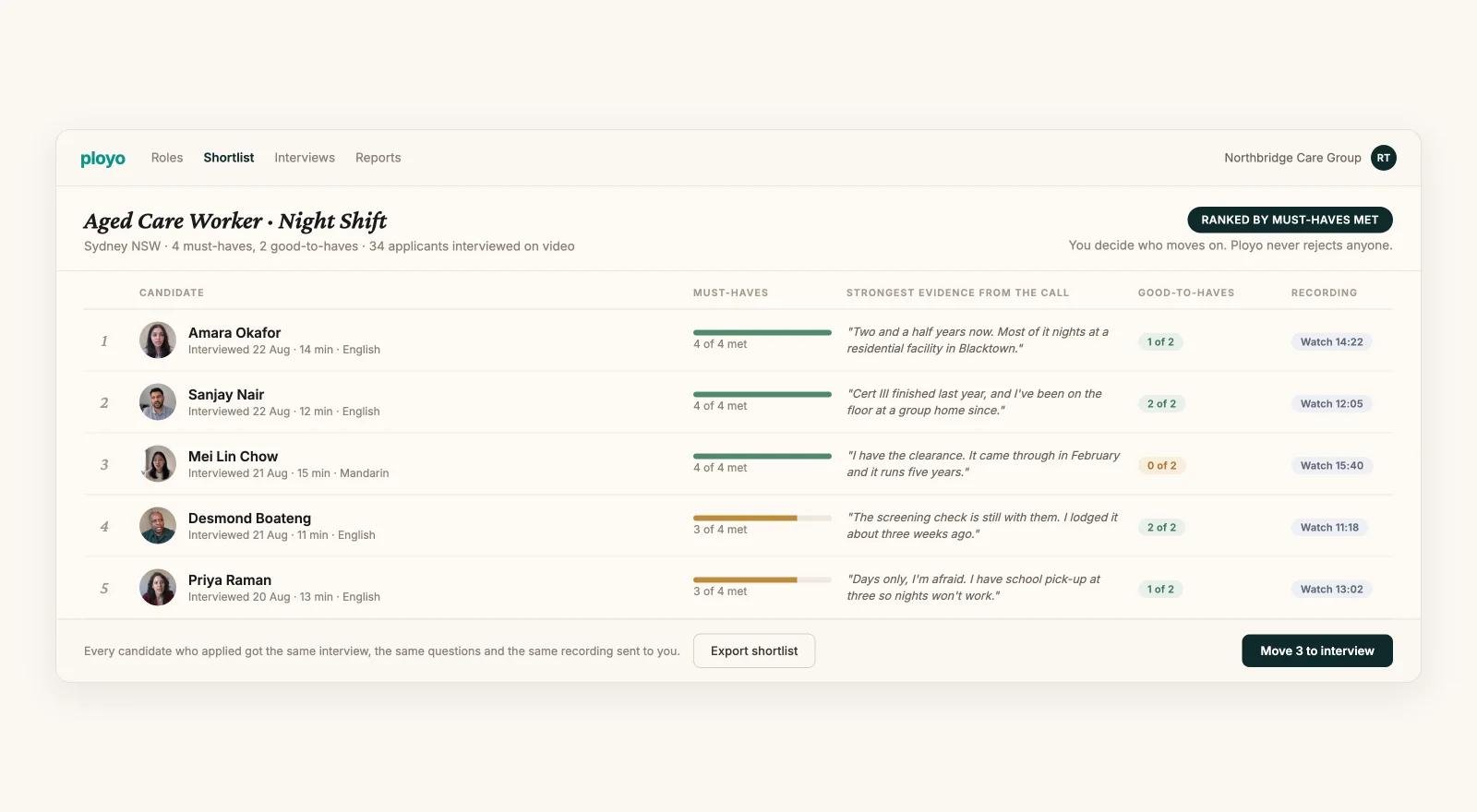
Full applicant coverage, not top-of-funnel sampling
Most AI screening tools force a trade-off: interview the top 5% of CVs or pay for an enterprise seat licence per recruiter. Ployo removes the trade-off. Every applicant who clears your CV requirements gets an adaptive AI video screening call, no sampling, no judgement-call rejections on phrasing alone. Strong candidates buried under unconventional CVs stop slipping through.
Throughput, not seats
Ployo doesn't bill by recruiter login. One workflow on one tenant runs as many parallel screening calls as your applicant flow demands, 50 a week or 5,000. The economics scale on completed screenings, not on how many people on your team have access to look at the dashboard. Add as many hiring managers, recruiters, and observers as you need.
One platform replaces three line items
Most high-volume hiring stacks layer a CV parser, a phone-screen tool, and a video-interview platform on top of an ATS. Ployo collapses applicant tracking, parsing, requirements matching, AI video screening, and full AI video interviewing into a single workflow, and pushes the ranked shortlist into another ATS where a team keeps one. The integration tax and the licence-stacking tax both drop.
Founder-led packaging matched to your hiring volume
Pricing is published, and it is priced on interviews rather than seats: US$249 a month for 60, $850 for 250, $2,135 for 800, and a custom Group plan for multi-site providers. A retail chain screening 50,000 seasonal applicants and a boutique home-care provider hiring a dozen support workers a quarter buy the same product on different plans. Add as many hiring managers as you need at no extra cost. The founder scopes the right plan against your actual volume and role mix on the call, so there is no per-seat tax and no surprise overage bill.
Compounding economics with every cycle
Every screening call generates a structured Met / Partial / Not-met result per question, plus a full transcript indexed against the role's requirements. Pass-rate reporting shows exactly which requirement is emptying the shortlist, so you can sharpen a weak requirement before the next cycle instead of guessing. The investment compounds; it doesn't reset every quarter.
Full applicant coverage without the headcount conversation.
- Every CV that clears requirements gets an AI screening call
- Adaptive follow-ups on vague answers, no manual re-screening
- Structured per-question results ready to forward in seconds
A defensible coverage story, every applicant assessed on the same requirements, every cycle.
- Time-to-shortlist measured in days, not weeks
- Audit trail proving identical screening of every candidate
- Compounding pass-rate visibility per requirement, cycle over cycle
No. The same in-call agent (Sarah) and post-call evaluator that screens for our enterprise customers screens for every customer. The economics come from architecture, throughput pricing instead of seat pricing, and one workflow replacing three stacked vendors, not from a cheaper LLM or a thinner interview.
Ployo tracks applicants through the stages itself, from applied to shortlisted, interviewed and hired, so for many teams it is the system of record. Where you keep an existing ATS, offers and contracts stay there. What Ployo replaces is the per-recruiter cost of getting from "applied" to "shortlisted", which is where most of the wasted seat-licence spend hides today. The ranked shortlist hands off to your ATS via API.
Book a Demo, a 30-minute call. Bring your applicant count from last quarter and the rough number of recruiter hours currently spent on phone screens. We'll walk through the throughput math on one of your live roles, if the economics don't shift in your favour, we'll say so.

Frequently asked
01Is Ployo really the most economical AI video screening platform?
For teams hiring at volume (typically 200+ applicants per role, or 10+ roles per quarter), yes, the throughput-based model wins clearly versus per-seat or per-interview pricing once volume crosses a threshold. The founder will walk through the numbers against your specific volume on the call. For very low-volume hiring, traditional point tools may still be cheaper.
02Why don't you publish prices on the website?
Two reasons. First, packaging genuinely varies, a retail chain screening 50,000 applicants and a home-care provider hiring a dozen support workers need different shapes of plan, and a single table would mis-serve both. Second, we've found that a 30-minute conversation with the founder gets to the right answer faster than a self-serve table that needs caveats. No high-pressure sales, just a real scoping conversation.
03Does "economical" mean candidates get a worse experience?
No. Sarah's call quality, her interview rigour, and the cheating-detection signals are identical across all customers. The economics come from architecture, not from cutting corners on the candidate side. Completion rates of 70%+ in pilots, well above industry average for one-way video interviews, confirm the experience holds up.
04What's the smallest workable engagement?
There's no minimum-seat licence. The founder will scope a plan that matches actual hiring volume, including pilots on a single role to validate fit before scaling.
05Can I see the throughput numbers before committing?
Yes, the founder runs Ployo on one of your live roles during the first call. You see actual per-applicant throughput, candidate experience, and structured results before any commitment.
TRUSTED BY HIRING TEAMS AT








See it on one of your live roles
Book a Demo, a 30-minute call. We'll set Ployo up on a role you're hiring for right now and walk through the shortlist.
30-minute call · See Ployo on one of your live roles