
Aged care worker interview questions: what to ask and why
Updated June 2026
An aged care interview that ends with 'so, why do you want to work in aged care?' tells you almost nothing. The candidates who will genuinely uphold resident dignity, report safety concerns promptly, and still be on the roster in twelve months are identifiable at interview, but only if you ask the right questions. This guide gives managers in residential and community aged care a practical, theme-organised question set, along with notes on what good answers actually look like.

Why structured interviews predict retention in aged care
Aged care turnover is persistently high, and a significant share of leavers depart within the first few months. Most of that early attrition isn't about pay or rostering; it's about fit. A worker who underestimated the emotional and physical demands of the role, or who doesn't share the values required to give genuinely person-centred care, will struggle and leave. A structured interview, same questions, same scoring, for every candidate, is the single highest-leverage tool for filtering on fit before someone is in the building. It also makes your process fairer and easier to defend, both important under the Aged Care Act 2024's tightened workforce obligations.
Compassion and dignity questions
These questions separate workers who understand dignity as a living practice from those who know it as a compliance term.
• "Tell me about a time you supported someone through a moment that was undignified for them, an accident, a fall, a moment of confusion. How did you handle it?" • "How do you maintain someone's privacy and dignity when providing personal care in a shared room?" • "A resident becomes verbally abusive toward you during a personal care task. What do you do?" • "What does a 'good day' look like for a resident in your care? Can you give me a specific example from your experience?"
Look for answers centred on the resident's experience, not the worker's reaction. Empathy in aged care is practical, not abstract.
Scenario-based care questions
Scenarios reveal judgement under pressure, which matters more in aged care than textbook knowledge.
• "You're doing a welfare check on a resident and notice they're more confused than usual and have a slight cough. You're the only AIN on the floor right now. What do you do?" • "A resident tells you they don't want to have a shower today. Their family has told you they must shower daily. How do you handle this?" • "You're helping a resident eat and realise they're struggling to swallow safely. What do you do?" • "A resident is crying quietly in their room and says they feel lonely. You have six more rooms to complete before handover. How do you respond?"
Strong candidates balance resident wellbeing with safe escalation and honest time management. Be wary of candidates who always escalate immediately without trying to solve the human problem first, or who always try to handle everything alone.
Compliance and safety questions
Under the Aged Care Act 2024 and the Strengthened Quality Standards, every worker has clear obligations around safety, reporting, and documentation. Test whether candidates understand them.
• "What would prompt you to fill out an incident report?" • "Have you ever witnessed something you felt was unsafe or unkind toward a resident? What did you do?" • "What do you know about the Aged Care Quality Standards, and how do they affect what you do day to day?" • "What is a restrictive practice, and what are the rules around using one?"
For candidates new to the sector, probe whether they understand that reporting concerns is a duty of care, not disloyalty. For experienced workers, listen for specifics rather than generalities.
Teamwork and communication questions
Aged care is a handover-dependent environment. A worker who doesn't communicate clearly or doesn't function well in a team directly puts residents at risk.
• "How do you write a care note? What do you always include?" • "Tell me about a time you disagreed with a colleague about how to support a resident. How did you resolve it?" • "How do you ensure a smooth handover at the end of a shift?" • "A senior colleague is doing something you think is unsafe. What do you do?"
Look for factual, specific care notes; a willingness to escalate genuine safety concerns even with a senior colleague; and a handover approach that centres continuity for the resident.
Resilience and sustainability questions
Aged care is emotionally and physically demanding. Workers who don't have strategies for managing that demand leave early, often burning out during the first few months.
• "Grief is part of aged care. How have you managed it when a resident you cared for passed away?" • "What does a hard shift look like for you, and how do you recover?" • "What attracted you to aged care specifically, rather than another care sector?" • "What has kept you in care work so far, or what do you think would keep you here?"
These questions aren't about finding people with no emotional response to hard work; they're about finding people who have developed realistic strategies for staying well enough to stay.
Screening these questions at volume across multiple vacancies
These questions work well in a face-to-face shortlist interview. The challenge is getting there: when you're hiring AINs and PCAs at volume across a facility or across multiple sites, you can't run every applicant through a structured face-to-face first. AI screening lets you run a consistent structured interview with every applicant the moment they apply, covering the values, scenario, and compliance questions that actually predict fit, and delivering a scored shortlist for your team to review. Your coordinators make every hiring decision; the AI ensures every applicant gets the same fair, thorough first round. See how Ployo supports aged care hiring below.
Ployo platform data
30,000+
AI Interviews Completed
340,000+
Candidate Answers Graded
70%+
Interview Completion Rate
15,000+
Recruiter Hours Saved
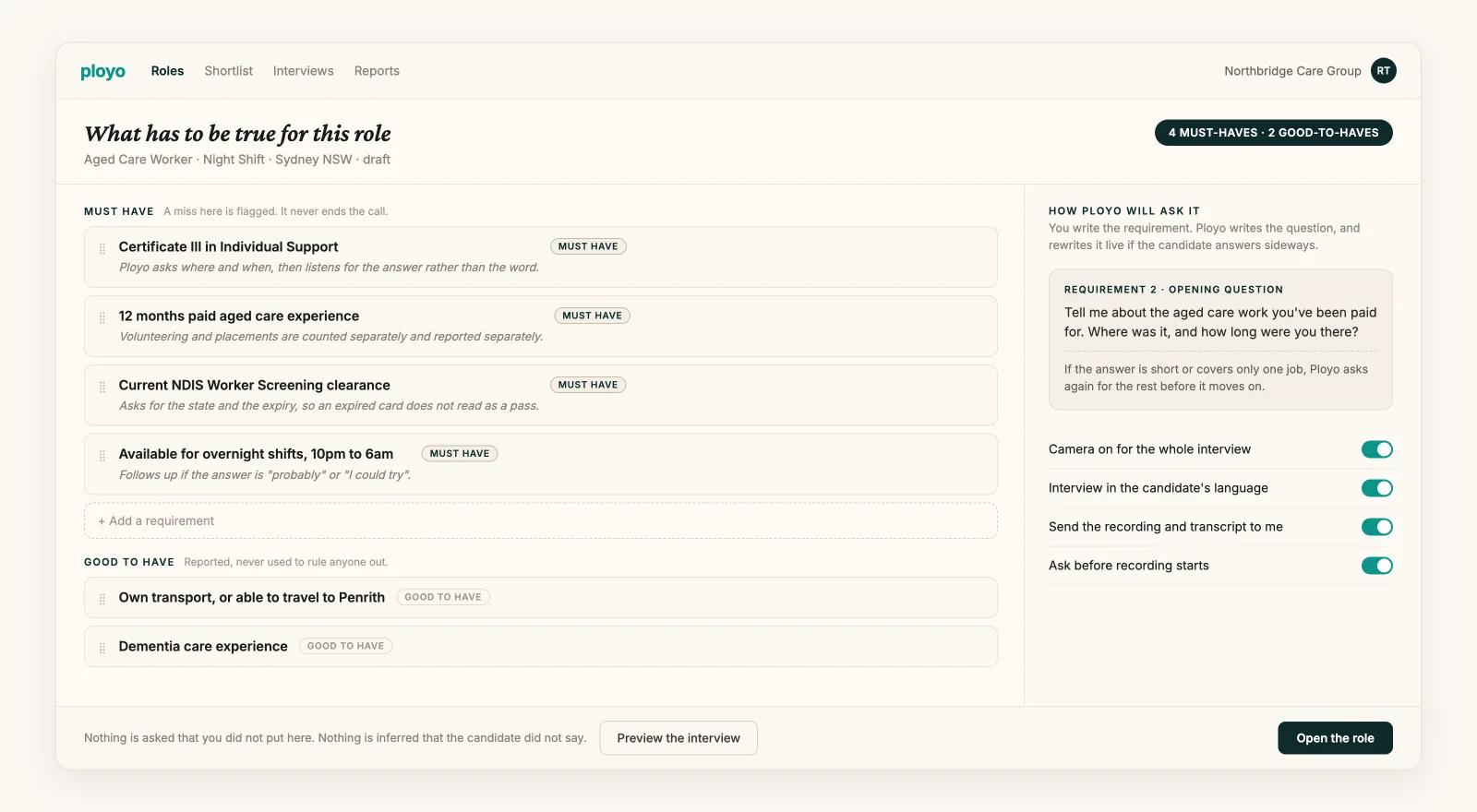
Set the requirements, not the questions
Frequently asked
What are the best interview questions to ask an aged care worker?
Group your questions by theme: compassion and dignity (how they handle undignified moments), scenario-based care (judgement under pressure), compliance and safety (incident reporting, Quality Standards), teamwork and communication (care notes, handover, raising concerns), and resilience (how they sustain themselves in emotionally demanding work). Ask the same questions of every candidate and score them against the same rubric for a fair, defensible process.
How do I interview aged care candidates fairly when I'm hiring at volume?
Consistency is what makes volume screening fair: the same questions, in the same order, scored against the same rubric, for every applicant. AI screening software like Ployo applies that structure to every applicant automatically, so you receive a ranked shortlist your team can review rather than triaging a stack of CVs by gut feel.
What mandatory checks do I need to run before hiring an aged care worker?
Roles with resident contact generally require a valid police certificate or worker screening clearance before starting, with records retained for the period required under the Aged Care Act 2024. A nationally consistent worker screening model is expanding into aged care. These statutory checks are separate from and additional to any values or suitability interview you run; they're non-negotiable compliance steps, not substitutes for a thorough interview process.
How do I predict whether an aged care worker will stay past three months?
Early attrition in aged care is mostly a fit problem, not a pay or rostering problem. Screening consistently for values (genuine person-centred care beliefs), resilience (realistic strategies for managing emotional and physical demand), and role understanding (knowing what the job actually involves) produces hires who stay. The interview questions in this guide are specifically chosen to surface those signals. Pairing structured interviews with deliberate first-90-days onboarding, a named buddy and early check-ins, protects the investment further.
TRUSTED BY HIRING TEAMS AT








Hiring right now? See it on a live role
Book a Demo, a 30-minute call. We'll set Ployo up on a role you're hiring for and walk through the shortlist together.
30-minute call · See Ployo on one of your live roles