
How to hire aged care workers in Australia: a practical 2026 guide
Updated June 2026
Hiring aged care workers in Australia has never been harder. Providers are competing for personal care assistants, AINs, and nurses against a national workforce shortage, a 30%-plus annual turnover rate, and a tightening compliance regime, while still needing to fill rosters this week. This guide walks through the full hiring process end to end: where to find candidates, how to screen them at volume without cutting corners, the mandatory checks you must run, and how better screening reduces the turnover that keeps the cycle going.

Why aged care hiring is uniquely hard right now
Three forces collide. First, demand: CEDA estimates Australia needs roughly 110,000 more aged care workers by 2036, and providers must meet mandated care-minute targets and 24/7 RN coverage, so an unfilled shift is a compliance risk, not just an inconvenience. Second, churn: sector turnover runs above 30% a year, meaning a large share of your hiring effort just replaces people who left. Third, stakes: a wrong hire in aged care is measured in resident wellbeing, not only a salary. Any hiring approach that treats aged care like generic recruitment will struggle on all three.
Where to source aged care workers
The reliable channels: job boards (SEEK and Indeed carry the bulk of aged care applicant volume in Australia); partnerships with Registered Training Organisations delivering the Certificate III in Individual Support, where you can recruit graduates before they hit the open market; employee referral programs, which consistently produce higher-retention hires in care; and re-engagement of past applicants and casuals. Don't over-invest in a single channel, the providers who fill fastest run several in parallel and keep a warm pipeline rather than starting from zero each vacancy.
The real bottleneck: screening at volume
Sourcing is rarely the constraint, screening is. A single role can attract hundreds of applicants, and no coordinator can meaningfully phone-screen them all, so most are rejected on a 7-second CV skim and strong, non-traditional candidates slip through. The fix is structured screening applied consistently to every applicant: the same questions, the same scoring, for everyone. This is exactly where AI screening earns its place, a tool like Ployo runs a structured interview with every applicant the moment they apply and returns a ranked, evidence-backed shortlist, so your team spends its time on the people worth talking to instead of reading CV piles.
Mandatory compliance and worker screening
Aged care hiring carries non-negotiable checks, and they tightened under the Aged Care Act 2024 (in effect from 1 November 2025). Before someone starts in a role with resident contact you generally need a valid police certificate or worker screening clearance, with statutory declarations permitted while a check is pending, and records kept for seven years. A nationally consistent, NDIS-style worker screening model is expanding into aged care from mid-2026. Treat these as separate, mandated steps, no screening tool, AI or otherwise, replaces a statutory clearance. The win is sequencing: confirm suitability first, then spend your compliance effort only on the candidates you actually intend to hire.
Running a values-based interview that predicts retention
Qualifications get someone in the door; values keep them, and keep residents safe. Build a short, structured set of behavioural questions around the things that actually predict success in care: empathy, patience, how a candidate handles a distressed or confused resident, and why they work in the sector. Ask every candidate the same questions and score them against the same simple rubric. Structure is what makes the comparison fair and removes the first-impression bias that creeps in by the fortieth interview of the week. If you're screening at volume, this is the part most worth automating consistently.
Onboarding and the first 90 days
Most avoidable turnover happens early. A structured first 90 days, a named buddy, clear shift expectations, early check-ins, and a genuine induction rather than a sign-here-and-start, pays back directly in retention. Hiring and onboarding aren't separate projects: the fit signals you screen for at interview are the same ones that determine whether someone is still on the roster in three months. Screening for values up front and onboarding deliberately is how you break the replace-the-leaver cycle.
A faster, fairer hiring workflow
Putting it together: source across a few channels, screen every applicant with a consistent structured interview, run statutory checks only on your shortlist, interview for values, and onboard deliberately. The step that scales worst manually is screening every applicant, which is why high-volume providers increasingly let AI run that first structured interview for everyone, with humans making every decision on an explainable, evidence-backed shortlist. See how Ployo does this for aged care providers below.
Ployo platform data
30,000+
AI Interviews Completed
340,000+
Candidate Answers Graded
70%+
Interview Completion Rate
15,000+
Recruiter Hours Saved
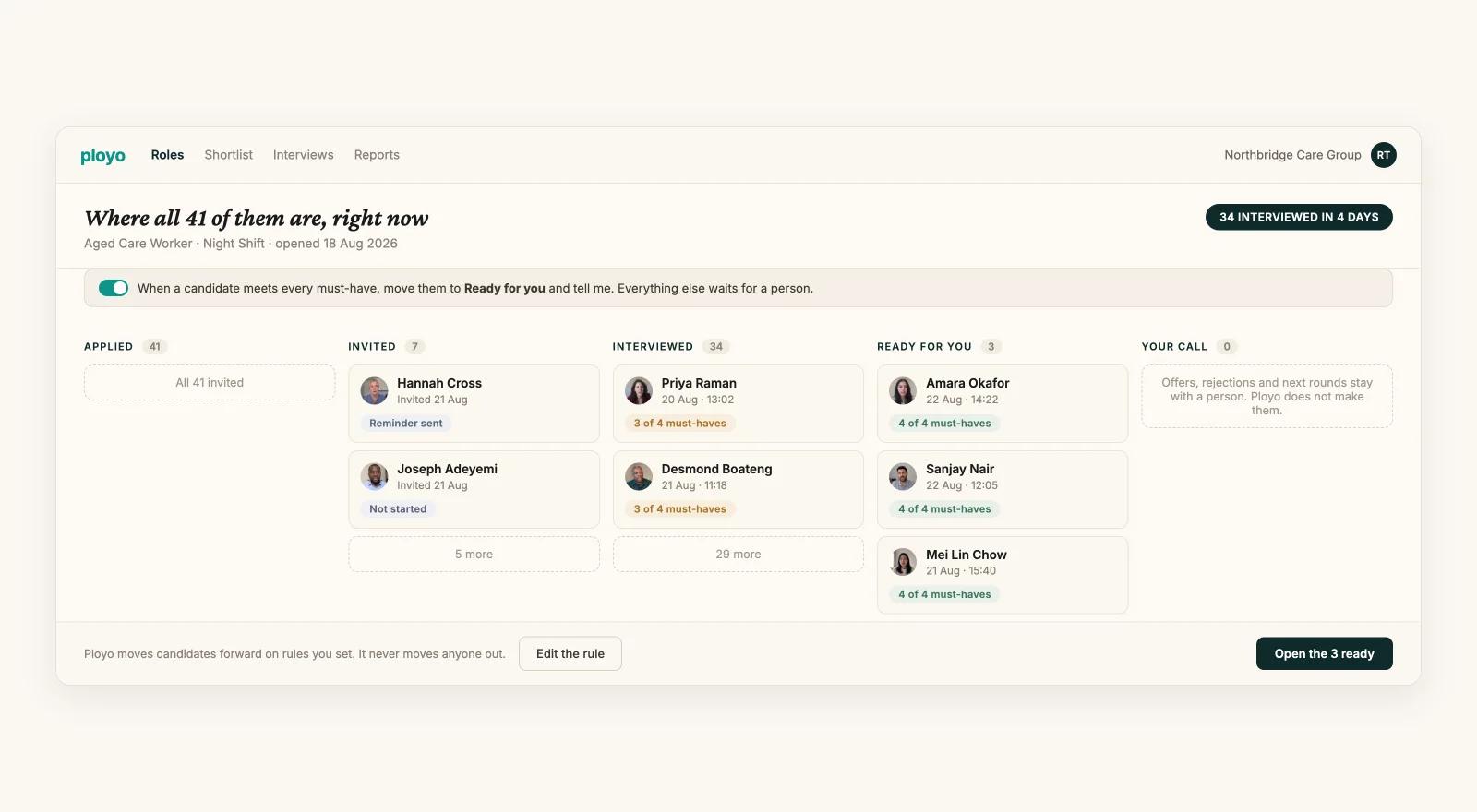
Where every applicant is, right now
Frequently asked
What qualifications do aged care workers need in Australia?
Most personal care and support roles look for a Certificate III in Individual Support (Ageing), though some providers hire and train. Nursing roles require AHPRA registration (RN or EN). Beyond qualifications, every role with resident contact requires a valid police certificate or worker screening clearance before starting, per the Aged Care Act 2024.
How can I screen hundreds of aged care applicants quickly?
Manual phone screening doesn't scale past a handful of candidates per role. The practical approach is a structured screening interview applied to every applicant, the same questions and scoring for everyone, which you can run at volume with AI screening software like Ployo. It interviews every applicant in parallel and returns a ranked, evidence-backed shortlist, while your team makes the hiring decisions.
What checks are mandatory when hiring aged care workers?
Roles with resident contact generally require a valid police certificate or worker screening clearance, with records retained for seven years, under the Aged Care Act 2024 (effective 1 November 2025). A nationally consistent worker screening model is expanding into aged care from mid-2026. These statutory checks are separate from, and additional to, any suitability or values screening you run.
How do I reduce turnover among aged care staff?
Turnover starts at hiring. Screening consistently for values and fit, not just qualifications, produces hires who are more likely to stay, and a deliberate first-90-days onboarding (buddy, clear expectations, early check-ins) protects that investment. Structured, consistent screening across every applicant is the foundation, because it surfaces fit signals you'd otherwise miss in a rushed CV skim.
TRUSTED BY HIRING TEAMS AT








Hiring right now? See it on a live role
Book a Demo, a 30-minute call. We'll set Ployo up on a role you're hiring for and walk through the shortlist together.
30-minute call · See Ployo on one of your live roles