
How to reduce aged care staff turnover: a practical guide for providers
Updated June 2026
Aged care workforce turnover in Australia is persistently high by any measure, and the cost is borne in three ways simultaneously: the direct cost of recruitment, the productivity loss during the gap, and the care quality impact on residents whose relationships with their workers are constantly disrupted. Most providers know they have a turnover problem. Fewer have a clear view of where in the employment lifecycle the problem actually starts, or which levers genuinely move it. This guide covers the causes, the retention strategies with the most evidence behind them, and how better hiring practices, specifically, reduce early-tenure churn before it starts.

Where turnover actually starts: the hiring decision
The single most common driver of early-tenure attrition in aged care is misfit: a worker who didn't fully understand what the role involved, or whose values around resident dignity and person-centred care don't align with what good care actually requires. This doesn't reflect dishonesty on the candidate's part; it reflects that most interviews don't surface it. A 20-minute chat asking why someone wants to work in care rarely distinguishes between a candidate who will stay and one who will leave after their first difficult shift. The practical implication is that the biggest lever on turnover is what happens before someone starts, specifically, how thoroughly and consistently you screen for fit, not just availability and qualifications.
Common causes of aged care staff turnover
The drivers vary by facility and workforce segment, but the most consistently reported ones are: poor values fit identified too late (post-hire); inadequate induction leading to workers feeling unprepared or unsupported in the first weeks; scheduling unpredictability and last-minute shift changes that make personal planning impossible; burnout from persistently understaffed shifts; limited career pathways or development opportunities for workers wanting to progress; and the cumulative emotional weight of grief and loss without adequate support structures. Not all of these are solvable at hiring, but several are, and hiring is the lever that compounds most with the others: a worker who is a better values fit will tolerate harder conditions longer.
Better hiring as a retention strategy
Screening specifically for values, role understanding, and resilience, rather than just qualifications and availability, produces hires who are more likely to stay. The practical steps: run a structured interview with every applicant (same questions, same scoring, not a casual chat); include scenario-based questions that reveal how a candidate actually responds when a shift is hard; ask directly about what strategies a candidate uses to manage the emotional demands of care work; and check for genuine understanding of what the role involves day-to-day, including personal care, dementia support, and end-of-life contact if relevant. Workers who enter with clear expectations are more likely to stay when those realities arrive.
Onboarding and the first 90 days
Most avoidable turnover in aged care happens within the first 90 days. A comprehensive induction, a named buddy or mentor, clear shift expectations from day one, and regular early check-ins (at two weeks, six weeks, and three months) protect the investment made in hiring. Providers who reduce the induction to a sign-here-and-start process, or who put new workers on the most difficult shifts or with the least support, should not be surprised when those workers leave. The first 90 days is when the implicit promise made at interview is either confirmed or broken, and the workers most likely to stay long-term are those who feel they were prepared honestly and supported genuinely from the start.
Scheduling, workload, and roster design
Aged care workers consistently cite unpredictable scheduling and understaffed shifts as primary reasons for leaving. While neither is entirely within individual providers' control given sector-wide workforce shortages, several roster design principles reliably reduce turnover: providing schedules as far in advance as operationally possible; minimising last-minute shift changes and the practice of calling workers in on days off; ensuring minimum staffing ratios that prevent individual workers carrying an unsafe load; and matching workers to the same residents over time where possible, which benefits residents and improves worker satisfaction and retention simultaneously. Consistent team composition is a retention lever, not just a care quality one.
Career pathways and development
Many aged care workers leave the sector, not because the work is hard, but because they see no path forward. Providers who visibly invest in development, covering Certificate IV in Ageing Support or bridging to enrolled nursing, creating senior AIN or team-leader roles, offering funded clinical education, retain more of their experienced workforce because there's a reason to stay. This doesn't require a large budget; it requires intentionality. A worker who is told they can progress with your organisation and sees that promise kept is meaningfully less likely to apply for a competitor's vacancy.
How structured screening reduces early-tenure attrition
All the retention levers above assume you've hired the right person to begin with. Structured screening applied consistently to every applicant, where AI runs the same set of values, scenario, and resilience questions with every candidate and returns a ranked, evidence-backed shortlist, is the fastest way to systematically improve hiring fit across a high-volume aged care workforce. Providers who've moved from unstructured CV-skim hiring to structured AI-assisted screening report better shortlist quality and fewer early-tenure departures. The mechanism is straightforward: workers who are screened more thoroughly enter with more realistic expectations, and workers who are a better values fit tolerate the demands of care work longer. See how Ployo does this for aged care below.
Ployo platform data
30,000+
AI Interviews Completed
340,000+
Candidate Answers Graded
70%+
Interview Completion Rate
15,000+
Recruiter Hours Saved
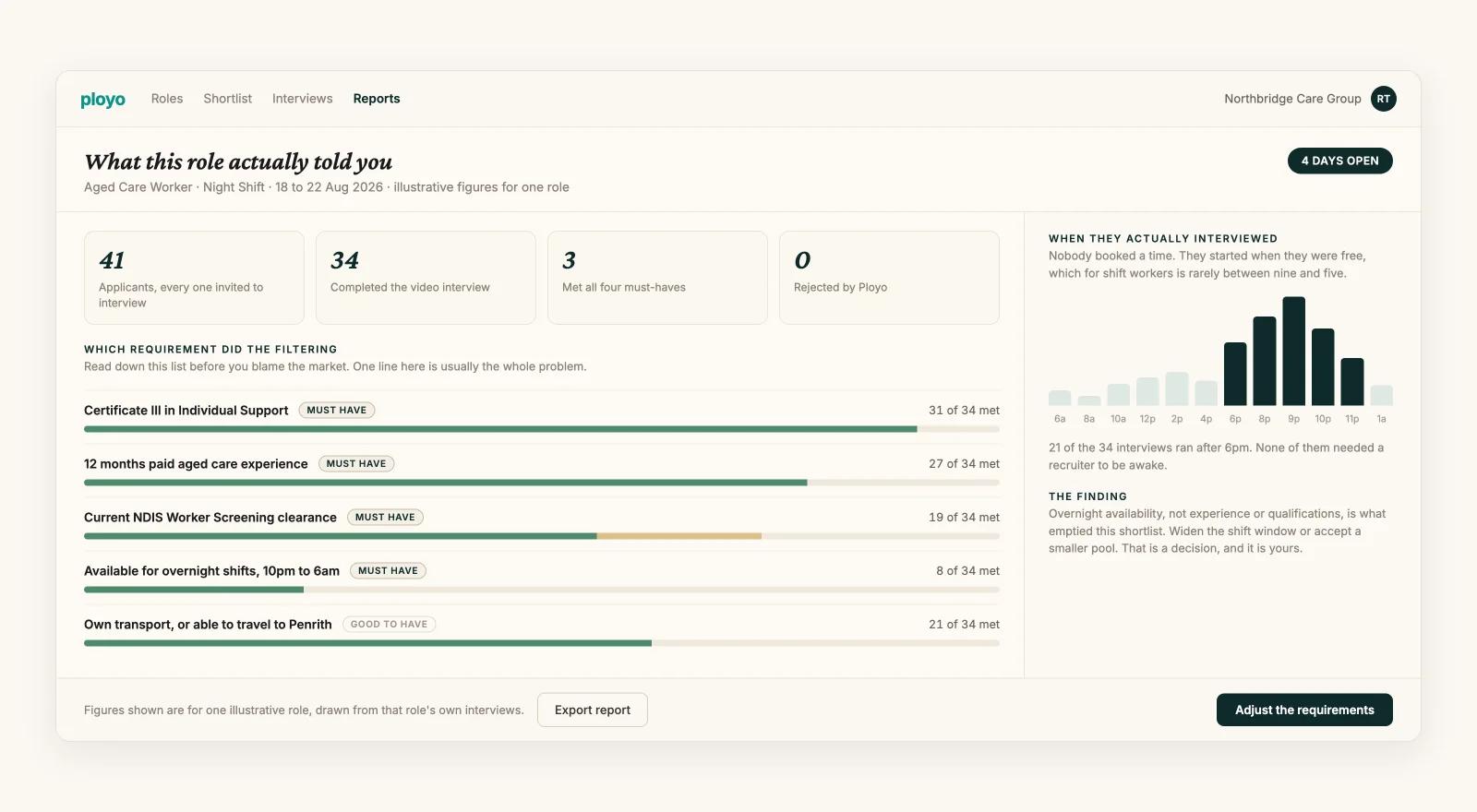
Which requirement actually emptied your shortlist
Frequently asked
Why is aged care staff turnover so high in Australia?
Turnover in aged care is driven by a combination of factors: poor fit identified too late (workers who didn't fully understand what the role involved), inadequate induction leaving workers unsupported in their first weeks, scheduling unpredictability, burnout from understaffed shifts, and limited visible career pathways. Hiring is the lever that compounds most with the others, because a worker who is a better values and fit match will tolerate harder conditions longer and stay through the difficult early months.
What are the most effective ways to retain aged care workers?
The evidence-backed levers are: structured values-fit screening at hiring (so workers enter with realistic expectations); a deliberate first-90-days onboarding with a named buddy and regular early check-ins; roster design that minimises unpredictability and ensures workers aren't carrying unsafe loads; consistent team-resident matching; and visible career development pathways. None of these work in isolation, but hiring quality compounds with all of them.
How does better screening reduce aged care turnover?
Most early-tenure attrition is a fit problem, not a pay or scheduling problem. Workers who are screened more thoroughly, through structured interviews covering values, scenario judgement, and role understanding, enter with more realistic expectations and are better matched to what the role actually involves. They are therefore more likely to stay through the inevitable hard shifts. AI screening tools like Ployo run this structured interview with every applicant at the point of application, so providers receive a shortlist of better-fit candidates before investing in induction.
How do you structure the first 90 days to reduce aged care attrition?
A named buddy or mentor from day one; a genuine induction (not just paperwork) covering the facility, the residents, and what a typical shift looks like; clear shift expectations set before the first day; and structured check-ins at two weeks, six weeks, and three months. The check-ins matter because they create a formal channel for early concerns to surface before a worker decides to leave quietly. Workers who feel prepared and supported in the first 90 days are significantly more likely to remain.
TRUSTED BY HIRING TEAMS AT








Hiring right now? See it on a live role
Book a Demo, a 30-minute call. We'll set Ployo up on a role you're hiring for and walk through the shortlist together.
30-minute call · See Ployo on one of your live roles