
How to screen nurse candidates faster in Australia
Updated June 2026
Healthcare hiring in Australia runs against a deepening nurse shortage, and the slowest part is almost always the first pass, coordinating screens around clinical shift patterns and reading applications one at a time. Every week a role stays open is another week of premium agency and overtime cost. This guide covers how to screen nurse and allied-health candidates faster without lowering the bar: what to screen for, how to work around shift schedules, verifying registration, and cutting time-to-hire and agency spend.

Why nurse screening is the bottleneck
Australia faces a projected shortfall of more than 70,000 nurses by 2035 (the federal Nursing Supply and Demand Study), so applicant quality and speed both matter. The specific friction in healthcare is scheduling: lining up a recruiter and a working nurse for a phone screen is a logistics problem before it's a hiring one, and it's repeatedly cited as the single biggest pre-screen bottleneck. Meanwhile the cost of delay is concrete, one state alone spent hundreds of millions on overtime and agency nurses in a single year. Faster screening is a direct lever on both fill rate and cost.
Define what you're actually screening for
Before speeding anything up, get specific about the bar: current AHPRA registration (RN or EN), relevant clinical experience, availability across the shift pattern you're filling, and the behavioural signals that reflect clinical judgement and patient-centred care. Writing this down as a simple rubric is what lets you screen consistently and fast, every candidate measured on the same dimensions, rather than re-deciding the criteria on every call.
Screen around shift work, not against it
The fastest healthcare teams stop trying to schedule synchronous phone screens and let candidates complete a structured screening interview on their own device, whenever they're free, between shifts, after a night roster, on a day off. Running this for every applicant in parallel removes the calendar bottleneck entirely. This is exactly what Ployo does: a structured AI interview with every applicant, 24/7, returning a ranked, evidence-backed shortlist your team reviews, so strong nurses don't drift to a faster employer while you're waiting on a callback.
Verifying AHPRA registration
Every nurse must hold current AHPRA / Nursing and Midwifery Board registration, with renewal due annually by 31 May, and you can verify status on the public Register of Practitioners. Capture each candidate's registration details early in screening so you can prioritise those ready to work and flag anything that needs checking, then verify against the register yourself. Capturing the detail up front is the time-saver; the verification step stays a manual, authoritative check.
Cut agency spend by hiring permanent faster
Every week a permanent role sits open is another week of agency and overtime premium. Compressing the first-pass screen, by interviewing every applicant the moment they apply and surfacing a shortlist overnight, is the most direct way to convert applicants into permanent hires before the agency invoice grows. Speed-to-shortlist isn't just a recruiter convenience in healthcare; it's a line-item on the budget.
A faster, fairer screening workflow
Put together: define the bar as a rubric, let every applicant screen asynchronously around their shifts, capture registration up front, and review a ranked shortlist instead of a stack of CVs. The step that scales worst manually is screening every applicant consistently, which is why health employers increasingly let AI run that first structured interview for everyone, with humans making every decision on an explainable shortlist. See how Ployo does this for Australian healthcare below.
Ployo platform data
30,000+
AI Interviews Completed
340,000+
Candidate Answers Graded
70%+
Interview Completion Rate
15,000+
Recruiter Hours Saved
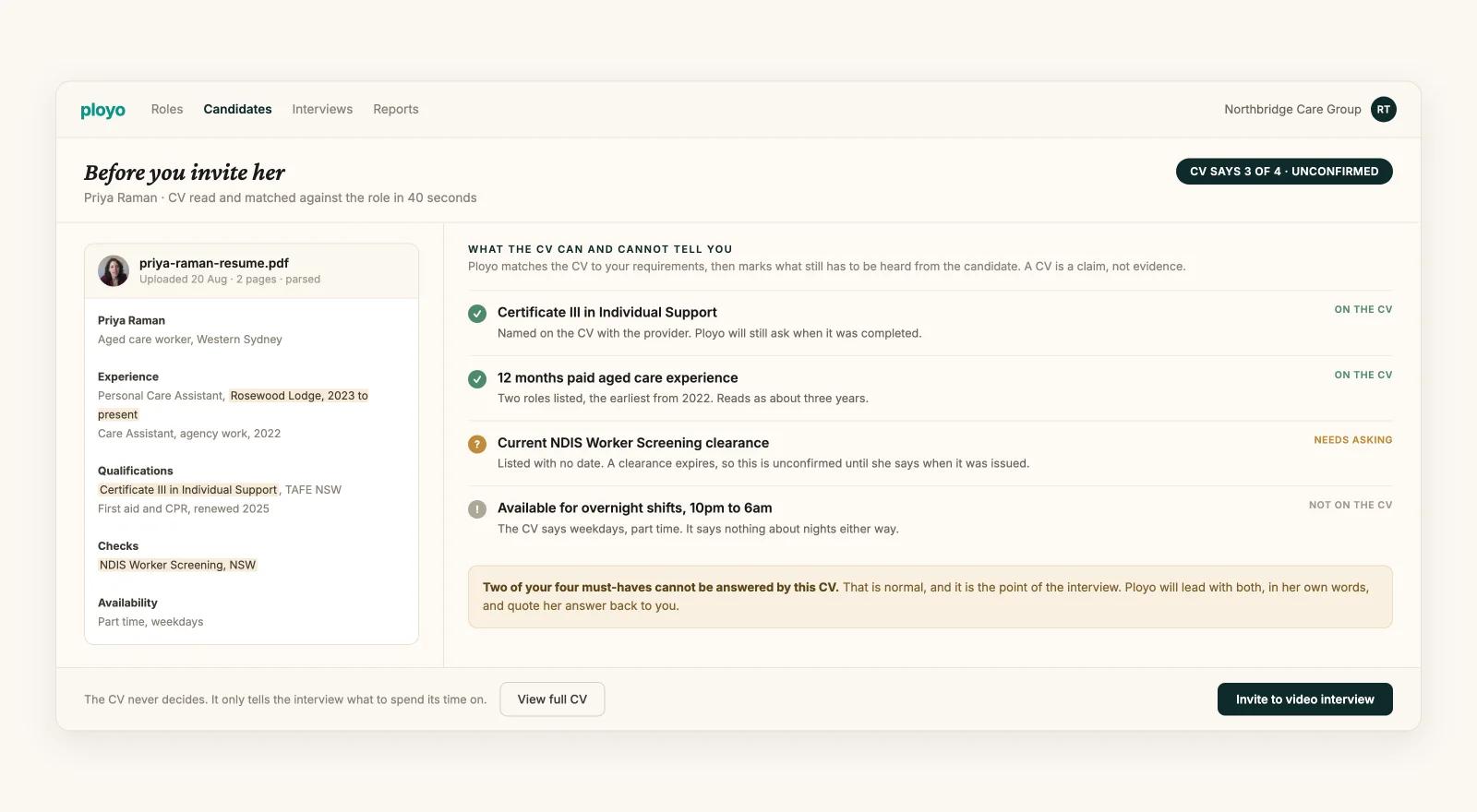
What the CV can and cannot tell you
Frequently asked
How can I screen nurse candidates faster without lowering standards?
Speed comes from consistency, not shortcuts: define a clear rubric, let every applicant complete a structured screening interview asynchronously around their shifts, and review a ranked, evidence-backed shortlist. AI screening software like Ployo runs that structured interview for every applicant in parallel, 24/7, so you screen faster while applying the same bar to everyone.
How do I verify a nurse's AHPRA registration?
Check the public AHPRA Register of Practitioners, which is updated regularly; nurses must hold current registration with renewal due annually by 31 May. Capture each candidate's registration details during screening so you can prioritise the ready-to-work, then verify against the register, the verification itself stays a manual, authoritative step.
How does faster screening reduce agency-nurse spend?
Agency and overtime premiums accrue for every week a permanent role is unfilled. By interviewing every applicant the moment they apply and producing a shortlist overnight, you convert applicants into permanent hires sooner, shortening the window where you're paying agency rates to cover the gap.
Is AI screening fair for healthcare candidates?
It can be more consistent than manual screening when built well: every candidate is asked the same questions and scored on the same rubric, which removes first-impression and interviewer-drift bias. With Ployo, the AI never auto-rejects, it surfaces evidence and a score, and your team makes every decision; candidates can also interview in their own language and on any device.
TRUSTED BY HIRING TEAMS AT








Hiring right now? See it on a live role
Book a Demo, a 30-minute call. We'll set Ployo up on a role you're hiring for and walk through the shortlist together.
30-minute call · See Ployo on one of your live roles