
Candidate screening software that talks to candidates
Most candidate screening software means keyword filters on a CV. Ployo's candidate screening software means an AI that parses every CV against your role's requirements with cited evidence, then actually talks to every candidate, a short AI video screening call to verify the must-haves, a full AI video interview for the ones who clear it, and hands your team a ranked shortlist with a verdict and a transcript behind every candidate. It plugs into the ATS you already run. It isn't one.
30-minute call · See Ployo on one of your live roles
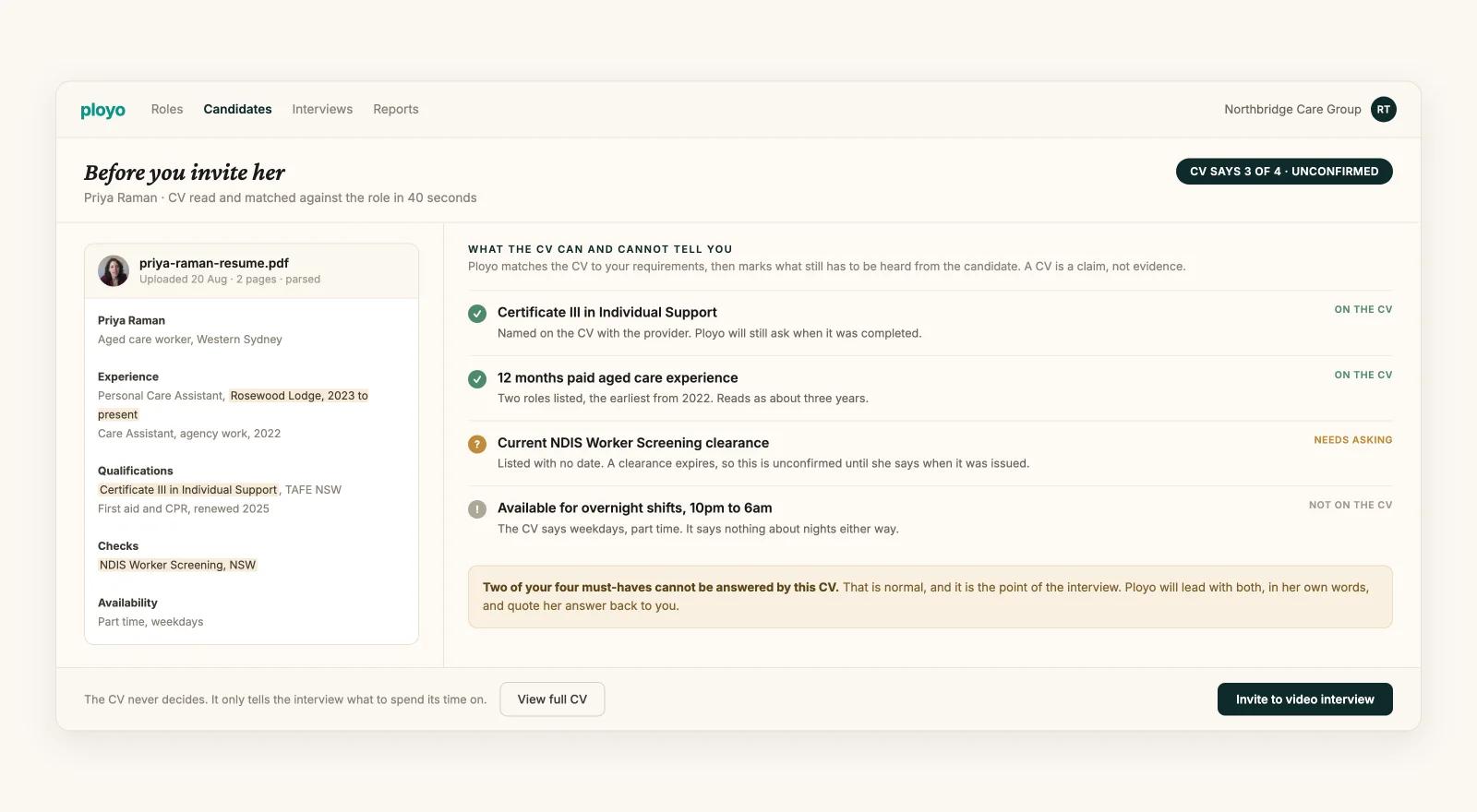
WHAT THE CV CAN AND CANNOT TELL YOU
What candidate screening software is
Candidate screening software is any tool that evaluates applicants against a role's requirements before a recruiter spends time on them, ranging from basic keyword matching on a resume to structured AI evaluation of a candidate's actual answers. The category exists because applicant volume routinely outruns the hours a recruiter has to review CVs by hand, let alone interview everyone who applies.
The Ployo take: real conversations, not keyword filters
Keyword filters reward CV-writing skill, not candidate quality, and they silently drop strong candidates whose resume happens to phrase things differently than the job description. Ployo's screening runs on evidence instead: the CV parse cites where a requirement is (or isn't) demonstrated, and the screening call and video interview verify what a resume can only claim, right-to-work, years of hands-on experience, a specific certification, in the candidate's own words. Good-to-have skills are checked too, and surface as red flags when missed, but they never mask a missed must-have.
Stage one: CV parse with cited evidence
Every uploaded resume is parsed and matched against the requirements, preferences, and disqualifiers extracted from your job description. Each match comes with the specific line from the CV that justifies it, met, partially met, or not met per requirement, so a recruiter can see the reasoning in seconds instead of re-reading the resume themselves.
Stage two: AI video screening call
Candidates who clear the CV parse (or all candidates, if you skip the CV gate) get invited to a short AI video screening call, 5 to 10 minutes, that verifies must-haves directly in conversation rather than trusting the CV. Spoken answers are the source of truth here: if a candidate confirms a requirement on the call that their CV understated, that confirmation counts.
Stage three: AI video interview
Candidates who pass screening move to a full, live, two-way AI video interview, camera on, adaptive follow-ups, recorded with a transcript, checked against the role's requirements. This is the depth pass: technical scenarios, behavioural questions, the kind of conversation a strong candidate needs to actually demonstrate skill in, not just claim it.
Output: a ranked, evidence-backed shortlist
Every candidate who completes the pipeline lands on a leaderboard grouped by verdict, with the CV evidence, the screening result, and the interview transcript all attached. Recruiters review the evidence and decide who advances. Ployo never rejects anyone: it only ever moves people forward, and the reject decision stays with a person.
Screening software vs an ATS
An applicant tracking system stores applications and manages pipeline stages. Ployo does both, and adds the part most systems leave to you: it parses every CV, runs a live AI video interview with every applicant, checks the answers against your requirements, and tracks each candidate through the stages from applied to shortlisted, interviewed and hired. If you're searching for "AI applicant tracking" because your current system stores applications without evaluating anyone, this is the layer that does the evaluating. Where a team already has an ATS they intend to keep, Ployo pushes the ranked shortlist into it instead.
The same answer, two formats
A first round is worth what it can find out. Both of these are real screening formats and both work; they differ in what happens after the candidate stops talking.
Typed answer
“One of our residents kept trying to leave at night. I sat with her, worked out she was looking for her husband, and changed her evening routine.”
Submitted, scored, and the interview moves to the next question. Written in private, at the candidate’s own pace, with every tab on their machine available to them.
Spoken answer
“One of our residents kept trying to leave at night. I sat with her, worked out she was looking for her husband, and changed her evening routine.”
And then, unscripted
“You changed the routine. Who signed that off, and what did you write in the notes?”
That second question did not exist until she gave the first answer. It is the one that separates a story a candidate can tell from a shift they actually ran.
Ployo platform data
30,000+
AI Interviews Completed
340,000+
Candidate Answers Graded
70%+
Interview Completion Rate
15,000+
Recruiter Hours Saved
A ranked shortlist with a CV citation, a screening verdict, and an interview transcript behind every candidate, tracked through Ployo's own pipeline and pushed into another ATS if you keep one.
- Per-requirement met / partially met / not met status, CV and interview both
- Full call and interview recordings plus transcripts
- One-click push of the ranked shortlist into your existing ATS
- Side-by-side comparison across shortlisted candidates
Every applicant actually evaluated on evidence, not filtered out by a keyword scanner before anyone sees them.
- Consistent, auditable evaluation process across every role
- Full pipeline visibility inside Ployo, from applied through shortlisted, interviewed and hired
- Pass-rate analytics per requirement, so you can see which one is emptying the shortlist
Frequently asked
01What is candidate screening software?
It's software that evaluates job applicants against a role's requirements before a recruiter invests time in them, ranging from basic resume keyword matching to, in Ployo's case, AI-driven CV analysis plus a real, live video conversation with every candidate.
02Is candidate screening software the same as an ATS?
Screening software evaluates candidates: CV analysis, screening calls, interviews, verdicts. An ATS stores applications and manages pipeline stages. Ployo is recruitment software with its own applicant tracking system built in, so it does both, and it also pushes results into an ATS you already run if your team keeps one.
03What does automated candidate screening actually automate?
The CV parse against your requirements, the follow-up video call that verifies must-haves in the candidate's own words, and the full video interview for candidates who clear screening. What stays manual, by design, is the hiring decision: a recruiter reviews the evidence and decides who advances.
04Does screening software replace recruiter judgment?
No. It removes the manual grunt work of reading every CV and phone-screening every applicant by hand, and hands recruiters a ranked, evidence-backed shortlist instead. The decision to advance, reject, or hire stays with a human at every stage.
05How does Ployo avoid the false negatives of a keyword filter?
Requirements are matched against what a CV actually demonstrates, with a cited line as evidence, and then verified in a live conversation rather than inferred from resume phrasing alone. A candidate whose CV undersells them still gets a real screening call and interview instead of getting auto-rejected for missing a keyword.
06Can screening software integrate with our existing ATS?
Yes, though you may not need to: Ployo tracks applicants through its own pipeline. Where a team keeps its existing system, Ployo pushes ranked shortlists into Greenhouse, Lever, Workday, Workable, Ashby, BambooHR and other ATS platforms, so your team keeps working from the system it already uses day to day.
07How is a candidate evaluated?
Every requirement you set is checked against what the candidate actually said, must-haves and good-to-haves both, with the specific evidence, a CV line or a transcript quote, cited for each one.
08What happens to candidates who don't meet a must-have?
They're flagged as not met on that requirement with the evidence shown, and the recruiter decides what to do with that, override, reject, or move forward anyway. The system never silently removes a candidate from view.
09Is this legal and compliant to use in hiring?
Every verdict and CV match is evidence-backed and reviewable by a human, and the platform is built for consistency across candidates rather than opaque automated rejection. Specific compliance requirements vary by jurisdiction and role; Book a Demo to go through your setup if that's a concern for your hiring process.

TRUSTED BY HIRING TEAMS AT








See it on one of your live roles
Book a Demo, a 30-minute call. We'll set Ployo up on a role you're hiring for right now and walk through the shortlist.
30-minute call · See Ployo on one of your live roles