
How to recruit NDIS support workers: a provider's 2026 guide
Updated June 2026
Since the NDIS, demand for disability support workers has outpaced every provider's capacity to recruit them well. You're hiring casual and shift staff at volume, accountable for safeguarding vulnerable participants, and competing with platforms and agencies for the same people. This guide covers the full process: where to source support workers, how to screen them at volume without compromising on safety, the mandatory Worker Screening Check, and how better screening reduces the turnover that drives the shortage.

Why recruiting support workers is so hard
The NDIS Review estimated Australia needs around 128,000 additional disability support workers to meet demand, roughly 40% growth on the existing workforce. At the same time, about one in four support workers leave their role each year, close to three times the general workforce. So providers are running fast just to stand still, hiring casual and shift staff who can move easily between employers, while carrying full accountability for participant safety. Generic recruitment tactics don't hold up against that combination of volume, churn, and risk.
Where to source NDIS support workers
Run several channels at once: job boards (SEEK and Indeed carry the bulk of support-worker applications), Registered Training Organisations delivering the Certificate III/IV in Individual Support or Disability, employee referrals (which reliably produce higher-retention hires in care), and your own past-applicant and casual pools. Self-managed-participant platforms like Mable and Hireup compete for the same workers, so your speed and candidate experience matter, a slow, silent process loses people to a faster employer within days.
The bottleneck: screening at volume
Most providers can source applicants; the constraint is screening them. A single role can draw hundreds of applications, and no coordinator can phone-screen them all, so most are rejected on a quick CV skim and good candidates are missed. The answer is a structured screening interview applied identically to every applicant. This is where AI screening fits: Ployo runs a structured interview with every support-worker applicant the moment they apply and returns a ranked, evidence-backed shortlist, so your coordinators spend their time on the people worth progressing instead of triaging a backlog.
The NDIS Worker Screening Check and compliance
Workers in risk-assessed roles at registered NDIS providers must hold a valid NDIS Worker Screening Check, assessed by your state or territory Worker Screening Unit, returning a 'cleared' or 'excluded' outcome valid for five years. This is a mandatory statutory check, no recruitment or AI tool performs it or replaces it. Treat it as a separate, required step. The practical win is sequencing: confirm a candidate's suitability and fit first, then run the statutory check on the people you actually intend to hire, rather than spending compliance effort on everyone.
Interviewing for values and safeguarding
In disability support, fit is a safeguarding issue, not a soft preference. Build a short, structured set of behavioural questions around dignity, person-centred support, communication, and how a candidate would respond to a participant in distress, and ask every applicant the same questions, scored against the same rubric. Structure is what makes the assessment fair and comparable, and it surfaces the human qualities that keep participants safe and predict whether a worker stays. The NDIS Quality and Safeguards Commission publishes recruitment and shortlisting guidance worth aligning your questions to.
Reducing support-worker turnover
With one in four workers leaving annually, retention is a recruitment problem solved at the front end. Screening consistently for values and fit produces hires more likely to stay; a deliberate first-90-days onboarding, a named contact, clear shift expectations, early check-ins, protects that investment. The fit signals you screen for at interview are the same ones that determine whether someone is still on the roster in three months, which is why consistent, structured screening of every applicant is the foundation of lower churn.
Ployo platform data
30,000+
AI Interviews Completed
340,000+
Candidate Answers Graded
70%+
Interview Completion Rate
15,000+
Recruiter Hours Saved
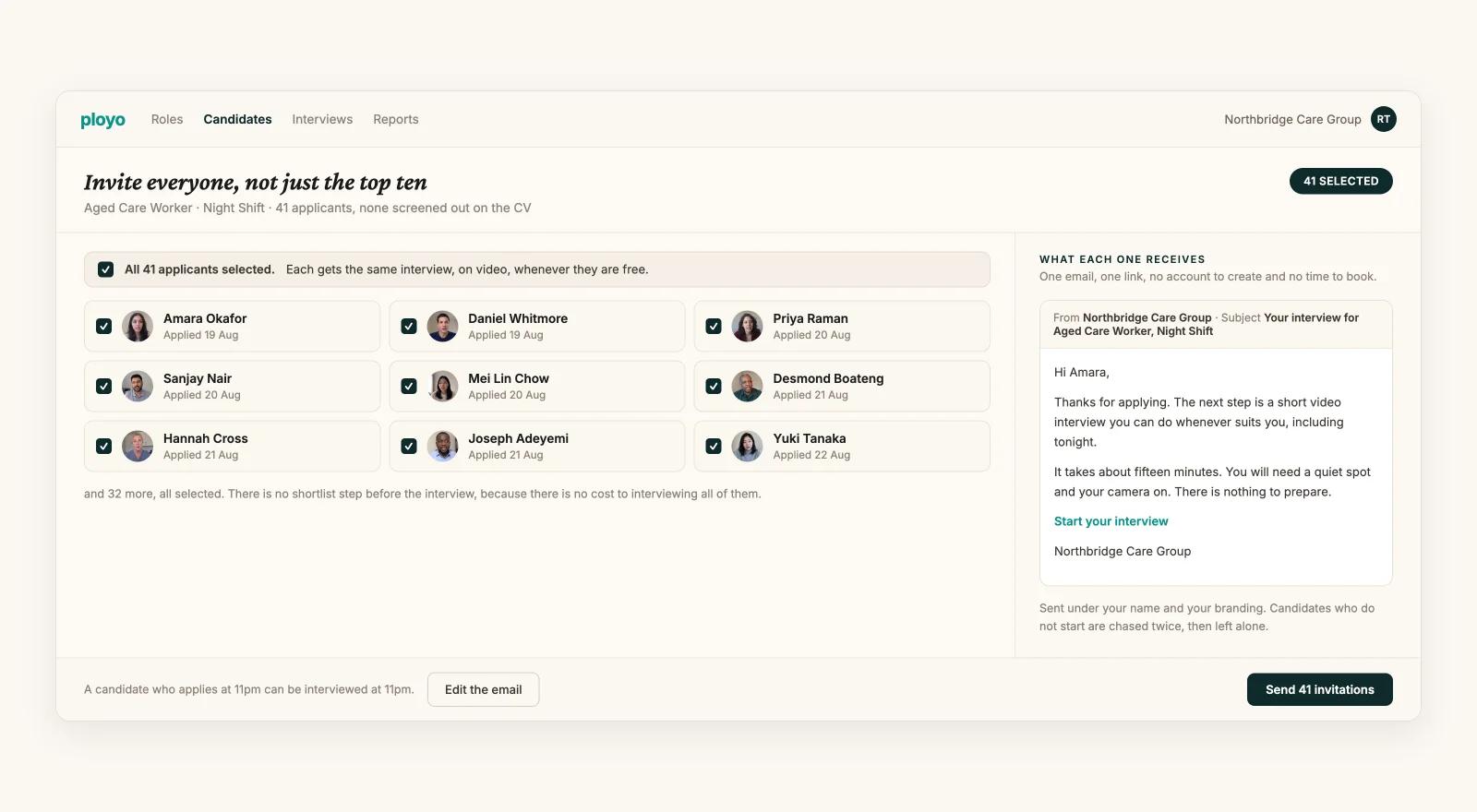
Invite everyone, not just the top ten
Frequently asked
What qualifications do NDIS support workers need?
There's no single mandated qualification, though many roles look for a Certificate III or IV in Individual Support or Disability. What is mandatory for risk-assessed roles is a valid NDIS Worker Screening Check. Beyond that, values, communication, and safeguarding judgement matter as much as paper qualifications, which is what a structured interview is for.
How do I screen large volumes of support-worker applicants?
Manual phone screening doesn't scale past a handful per role. A structured screening interview applied to every applicant, same questions, same scoring, is the practical approach, and AI screening software like Ployo runs it at volume in parallel, returning a ranked, evidence-backed shortlist while your team makes the decisions.
Does recruitment software handle the NDIS Worker Screening Check?
No. The NDIS Worker Screening Check is a statutory check assessed by your state or territory Worker Screening Unit, valid for five years. No recruitment or AI tool performs it or replaces it. Tools like Ployo screen suitability and fit and give you a documented read on every applicant before you run that mandatory check on your shortlist.
How can I reduce support-worker turnover?
Turnover starts at hiring. Screening consistently for values and safeguarding fit, not just availability, produces hires more likely to stay, and a structured first-90-days onboarding protects that. Consistent, structured screening of every applicant is the foundation, because it surfaces fit signals a rushed CV review misses.
TRUSTED BY HIRING TEAMS AT








Hiring right now? See it on a live role
Book a Demo, a 30-minute call. We'll set Ployo up on a role you're hiring for and walk through the shortlist together.
30-minute call · See Ployo on one of your live roles