
NDIS support worker interview questions: a hiring manager's guide
Updated June 2026
Finding a support worker who holds the right qualifications is step one. Finding one who will actually keep participants safe, communicate well with families, and show up reliably for shifts is harder, and that's what the interview is for. This guide gives hiring managers at NDIS providers a practical set of interview questions grouped by theme, along with guidance on structuring the process so you can compare candidates fairly when you're hiring at volume.

Why structured interviews matter for support worker hiring
In disability support, an unstructured chat-style interview is a safeguarding risk. Without a consistent question set and a scoring rubric, you end up comparing apples and oranges across candidates, and the person who interviews best on the day, rather than the one who will do the best job, is more likely to get through. Structured interviews, the same questions in the same order scored against the same criteria, produce more accurate predictions of on-the-job performance and are far easier to defend if a hiring decision is later questioned. For roles where the safety and dignity of participants depend on individual worker judgement, that consistency is non-negotiable.
Values and person-centred support questions
These questions surface whether a candidate genuinely understands and believes in the values that underpin NDIS support, rather than just repeating the right phrases.
• "Can you describe a time when you supported someone to make a choice that you personally disagreed with? What did you do?" • "What does 'person-centred support' mean to you in practice, not as a definition, but in a real shift?" • "How do you build trust with a participant who is non-verbal or has limited communication?" • "Tell me about a moment you felt genuinely proud of the support you gave someone."
Look for answers that centre the participant's autonomy and wellbeing, not what made the worker's job easier.
Lived experience and scenario-based questions
Scenario questions reveal how a candidate actually thinks under pressure, not just what they know in theory.
• "A participant you support becomes visibly distressed during a community outing and asks to go home, but the activity was planned by their family. How do you handle it?" • "You arrive for a shift and notice an unexplained bruise on a participant who cannot tell you what happened. Walk me through exactly what you do." • "A participant's family member asks you to do something that isn't in the participant's support plan and that you think the participant wouldn't want. What do you do?" • "Tell me about a time a participant's needs changed unexpectedly mid-shift. How did you adapt?"
Good answers prioritise the participant's rights and wellbeing, follow proper escalation channels, and demonstrate calm, methodical thinking.
Safeguarding and mandatory reporting questions
Every worker in a risk-assessed NDIS role is a mandatory reporter. These questions test whether a candidate understands their obligations without you having to prompt them.
• "What would make you concerned that a participant is being harmed or neglected, and what would you do?" • "Have you ever had to make a mandatory report? Can you walk me through what happened and what steps you followed?" • "What is the NDIS Commission, and in what situations would you contact them directly?" • "How do you balance a participant's right to privacy with your duty to report a concern?"
For candidates new to the sector, probe whether they understand that reporting is a professional duty, not a betrayal of the participant.
Reliability, transport, and availability questions
Consistency is a genuine care need for many participants. An unreliable worker causes distress, not just inconvenience. These questions are direct and practical.
• "Can you reliably cover [describe your shift pattern] without a car? If you drive, is your licence current and is your vehicle registered?" • "What would happen on your end if you woke up on a shift day feeling unwell? Walk me through how you'd handle that." • "Have you worked casual or shift-based roles before? How did you manage the unpredictability?" • "Are there any restrictions on the types of support you can provide, for example personal care, manual handling, or community access?"
These aren't trick questions. You're looking for honest, self-aware answers that match your rostering reality.
Communication and teamwork questions
Support workers hand over to colleagues, interact with family members, and often coordinate across teams. Communication breakdowns directly affect participants.
• "How do you write a shift note? What do you include, and what do you leave out?" • "Tell me about a time you disagreed with a colleague about how to support a participant. How did you resolve it?" • "A participant's family member regularly calls you on your personal number outside of shift time. How do you manage that?" • "How do you ensure continuity for a participant when handing over to the next worker?"
Look for candidates who write clear, factual notes, manage professional boundaries, and understand that continuity of information is part of good care.
Running these questions at volume with AI screening
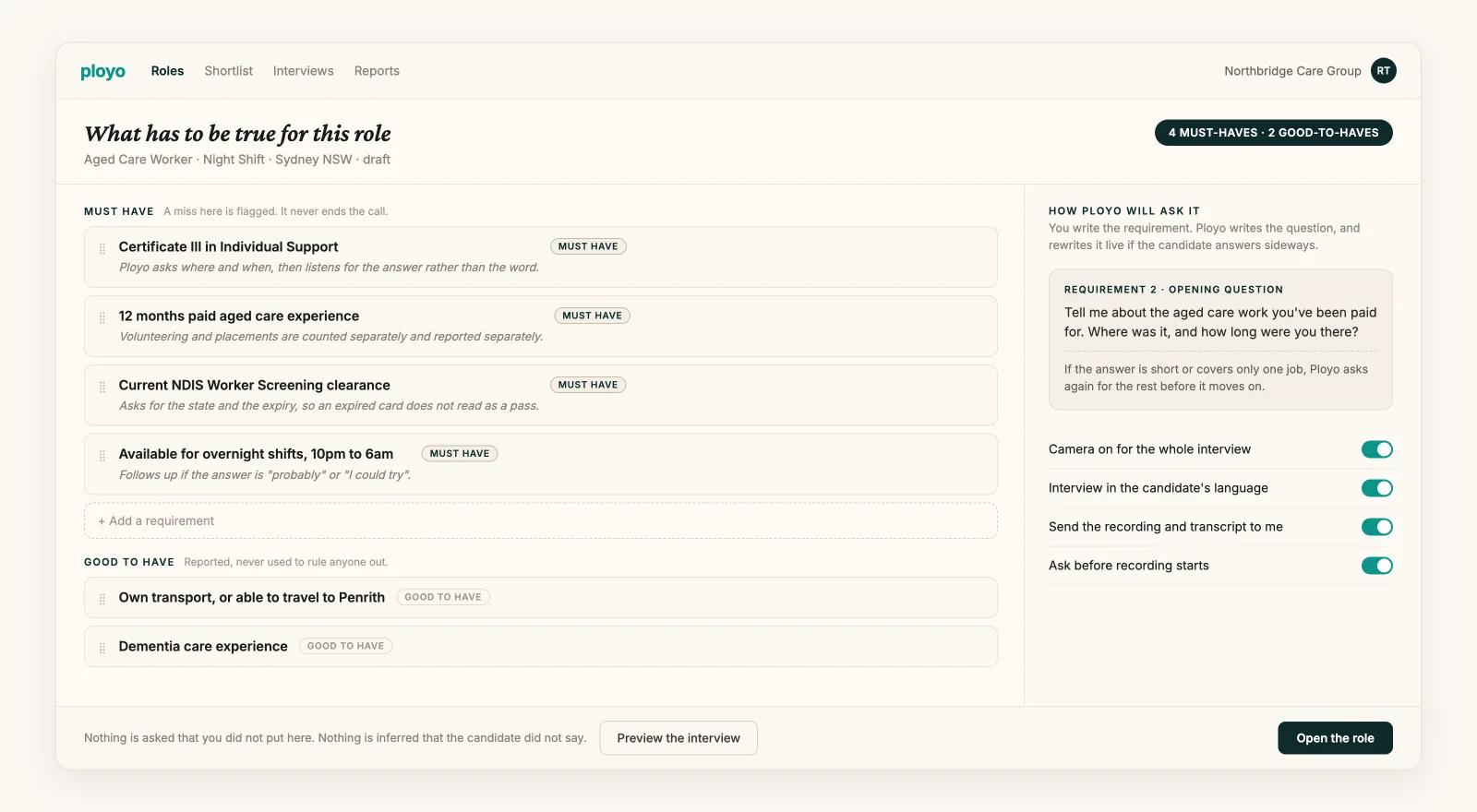
Asking these questions in a one-on-one interview works well for shortlisted candidates. But when you're hiring multiple support workers across several vacancies, manually running every applicant through this set isn't realistic. AI screening lets you run a structured interview with every applicant the moment they apply, asking the same questions, in the same order, with consistent scoring, so your coordinators receive a ranked, evidence-backed shortlist rather than a pile of CVs to triage. Your team still makes every hiring decision; the AI ensures that every applicant gets a fair, thorough first-round interview regardless of how many you're processing. See how Ployo supports NDIS and disability support recruitment below.
Ployo platform data
30,000+
AI Interviews Completed
340,000+
Candidate Answers Graded
70%+
Interview Completion Rate
15,000+
Recruiter Hours Saved
Set the requirements, not the questions
Frequently asked
What questions should I ask a disability support worker in an interview?
Focus on four areas: values and person-centred care (to test genuine understanding, not buzzwords), scenario-based questions about real situations like participant distress or unexplained injury, safeguarding and mandatory reporting (every NDIS risk-assessed worker is a mandatory reporter), and practical questions about reliability, transport, and availability. Ask the same questions of every candidate and score against a simple rubric so you can compare fairly.
How do I screen NDIS support workers at volume without losing quality?
The answer is consistency, not shortcuts. A structured interview, the same questions and scoring for everyone, applied to every applicant with an AI screening tool like Ployo, lets you screen every applicant in parallel and review a ranked, evidence-backed shortlist. Your team makes every decision; the AI ensures no applicant is rejected on a 7-second CV skim.
What mandatory checks do I need to run before hiring an NDIS support worker?
Workers in risk-assessed roles at registered NDIS providers must hold a valid NDIS Worker Screening Check, assessed by your state or territory Worker Screening Unit, returning a cleared or excluded outcome valid for five years. This is a statutory check that no recruitment or AI tool performs or replaces. Run it as a separate, required step after you've confirmed suitability through your interview process.
How do I make NDIS support worker interviews fair and legally defensible?
Use a structured format: the same questions in the same order, scored against the same rubric, for every candidate. Avoid questions about personal characteristics unrelated to the role. Document your scoring. Structured interviews are both more predictive of job performance and much easier to defend if a hiring decision is later questioned. If you're screening at volume, AI screening software ensures the structure is applied consistently, not just in theory.
TRUSTED BY HIRING TEAMS AT








Hiring right now? See it on a live role
Book a Demo, a 30-minute call. We'll set Ployo up on a role you're hiring for and walk through the shortlist together.
30-minute call · See Ployo on one of your live roles