
NDIS Worker Screening Check: what providers need to know
Updated June 2026
The NDIS Worker Screening Check is a mandatory requirement for workers in risk-assessed roles at registered NDIS providers in Australia. It exists to protect participants from people who pose an unacceptable risk of harm, and getting it wrong, either by allowing an uncleared worker into a risk-assessed role or by misunderstanding which roles are covered, is a serious compliance failure. This guide explains what the check is, who it applies to, how the process works, what clearance and exclusion mean, and how to integrate it practically into your hiring workflow without slowing everything down.

What the NDIS Worker Screening Check is
The NDIS Worker Screening Check is a national assessment process that determines whether a person poses an unacceptable risk of harm to NDIS participants. It is administered by Worker Screening Units in each state and territory, which assess a range of information including criminal history, apprehended violence orders, professional conduct findings, and other relevant matters. The check returns one of two outcomes: 'cleared' (the person may work in risk-assessed roles) or 'excluded' (they may not). It was introduced as part of the NDIS Quality and Safeguards framework to create a consistent, portable national standard, replacing the patchwork of state-level checks that existed before.
Who needs an NDIS Worker Screening Check
The check is required for workers in 'risk-assessed roles' at registered NDIS providers. Risk-assessed roles are defined as those involving: delivering supports directly to participants; likely unsupervised contact with participants; or access to participants' personal or financial information. This covers the vast majority of direct support workers, coordinators of supports, and anyone with direct participant contact. Some roles, such as purely administrative positions with no participant contact, may not be risk-assessed, but if you're in any doubt, the default assumption should be that the check is required. Key-personnel roles (such as people who make decisions that affect the registered provider) also require the check. Your state or territory Worker Screening Unit is the authoritative source on which roles qualify, not this guide.
How the application process works
The application is made by the worker themselves (not the employer), though you can initiate the process and support workers through it. Workers apply through their state or territory Worker Screening Unit, providing identity documents and consenting to the relevant checks. The processing time varies by state and can vary further depending on individual circumstances, so factor this into your hiring timeline and do not allow an uncleared worker to commence a risk-assessed role while waiting. Some providers use a statutory declaration as an interim measure for workers in the process, but you should check your obligations and the specific rules in your jurisdiction, as these arrangements are regulated and time-limited.
Clearance, exclusion, and interim bars
A 'cleared' outcome means the Worker Screening Unit has assessed the worker and determined they do not pose an unacceptable risk. It is valid for five years and is portable, so a worker cleared while at one provider can use that clearance at another within the validity period without reapplying. An 'excluded' outcome means the worker cannot work in any risk-assessed role with a registered NDIS provider. There is also a category of 'interim bar' that can be applied while an application is under assessment, which prohibits the person from commencing a risk-assessed role until the assessment is complete. Employers have obligations when they become aware of a worker's exclusion or interim bar, including ceasing the employment in risk-assessed roles; your Worker Screening Unit guidance covers these in detail.
What the check does and does not cover
The NDIS Worker Screening Check is a necessary safeguard, not a complete risk management system. It identifies people with relevant criminal histories, professional conduct findings, or other risk indicators, but it does not assess values, communication quality, clinical judgement, or the everyday behaviours that make a safe and effective support worker. A worker can be cleared and still be a poor fit for your organisation or a poor values match for person-centred support. The check should therefore sit within a broader hiring process that also screens for the skills, values, and safeguarding judgement that the statutory check cannot assess. This is where a structured interview adds the most value: on the dimensions the check does not cover.
Integrating the check into your hiring workflow
The most practical approach is to sequence the check correctly rather than running it in parallel with everything else or requiring it before even considering an applicant. A recommended workflow: (1) advertise and screen applicants using your structured interview process to identify who you actually want to hire; (2) make a conditional offer to your preferred candidate; (3) initiate or request the Worker Screening Check as part of pre-commencement checks; (4) allow the candidate to commence only once the check returns a cleared outcome or the relevant interim arrangements are properly in place. Running the check on everyone who expresses interest is impractical and unnecessary; running it only after you've identified the right person via a thorough interview process is the efficient, compliant approach.
Using AI screening to manage volume before the compliance step
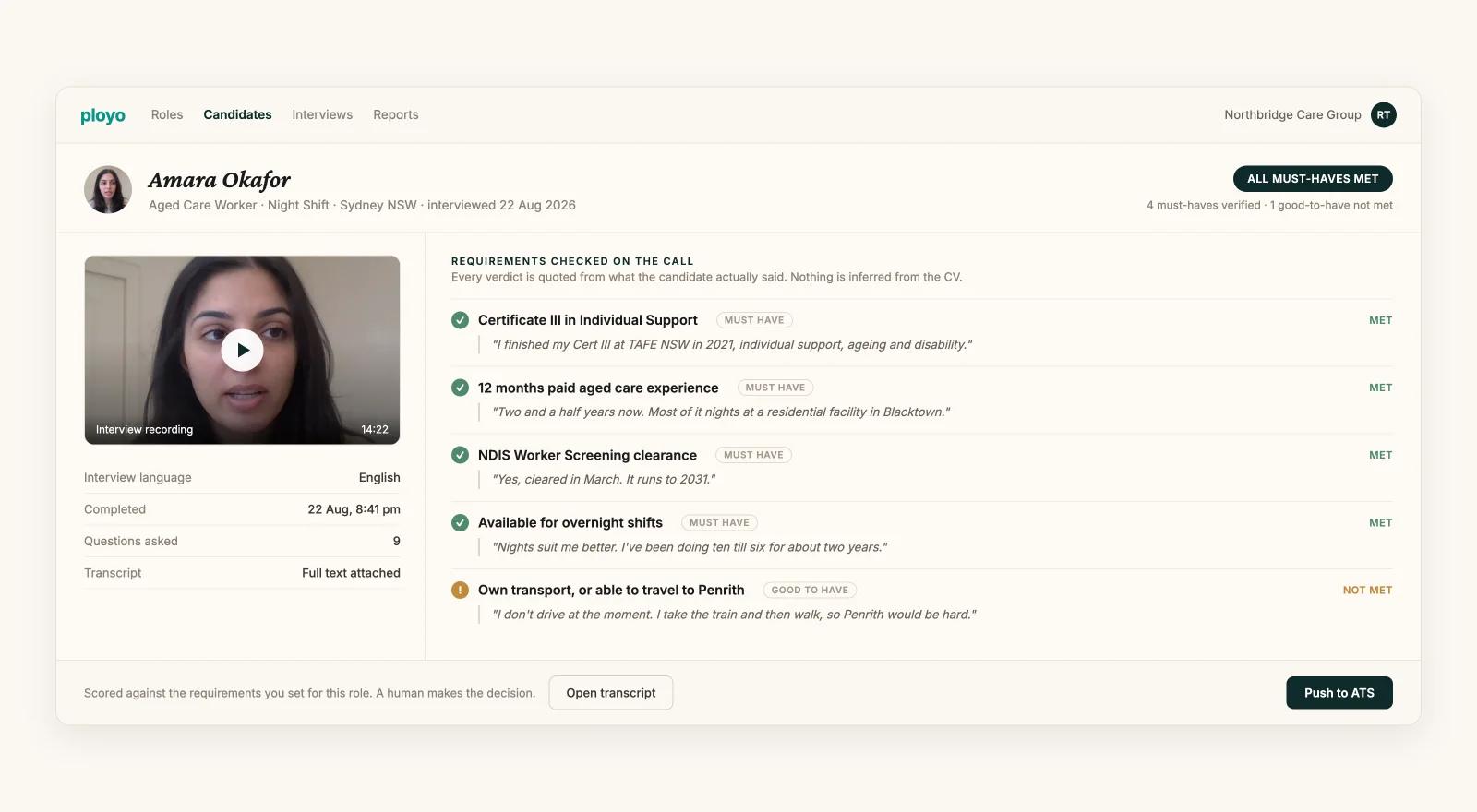
The compliance requirement is binary: the check is a non-negotiable gate. What you can control is how efficiently you identify the candidates worth running it on. AI screening lets you conduct a structured, consistent interview with every applicant the moment they apply, covering values, scenario judgement, and safeguarding understanding, and delivers a ranked, evidence-backed shortlist your team then interviews formally. You invest your compliance and onboarding effort, including the Worker Screening Check, only in the candidates you actually intend to hire. This is especially important when hiring at volume, where the cost and friction of running statutory checks on every applicant would be prohibitive. See how Ployo supports NDIS provider hiring below.
Ployo platform data
30,000+
AI Interviews Completed
340,000+
Candidate Answers Graded
70%+
Interview Completion Rate
15,000+
Recruiter Hours Saved
Every verdict quoted from the call
Frequently asked
Who needs an NDIS Worker Screening Check?
Workers in 'risk-assessed roles' at registered NDIS providers, which covers most direct support workers, support coordinators, and anyone with direct or likely unsupported contact with participants. Key personnel at registered providers also require the check. If you're uncertain whether a specific role qualifies, contact your state or territory Worker Screening Unit, which is the authoritative source.
How long is an NDIS Worker Screening Check valid for?
A cleared outcome is valid for five years and is portable across registered NDIS providers in Australia, meaning a worker doesn't need to reapply when moving between employers within that period. It is not automatically renewed; workers need to reapply before expiry if they intend to continue working in risk-assessed roles.
Can a worker start before their NDIS Worker Screening Check is complete?
This depends on your jurisdiction and the specific circumstances. Some states permit statutory declarations as an interim arrangement for workers in the application process, but these are regulated, time-limited, and do not apply in all situations. You should check the rules in your state or territory and not assume an interim arrangement is available. Allowing an uncleared worker to commence a risk-assessed role without the correct interim process in place is a compliance failure.
Does the NDIS Worker Screening Check replace other background checks?
No. The check assesses criminal history, professional conduct findings, and other risk indicators, but it does not assess values, clinical competence, communication quality, or the everyday behaviours that make a safe support worker. You should still run a thorough, structured interview process covering these dimensions alongside the statutory check, not instead of it. The check is a necessary gate; the interview is where you assess the dimensions the check cannot.
TRUSTED BY HIRING TEAMS AT








Hiring right now? See it on a live role
Book a Demo, a 30-minute call. We'll set Ployo up on a role you're hiring for and walk through the shortlist together.
30-minute call · See Ployo on one of your live roles